

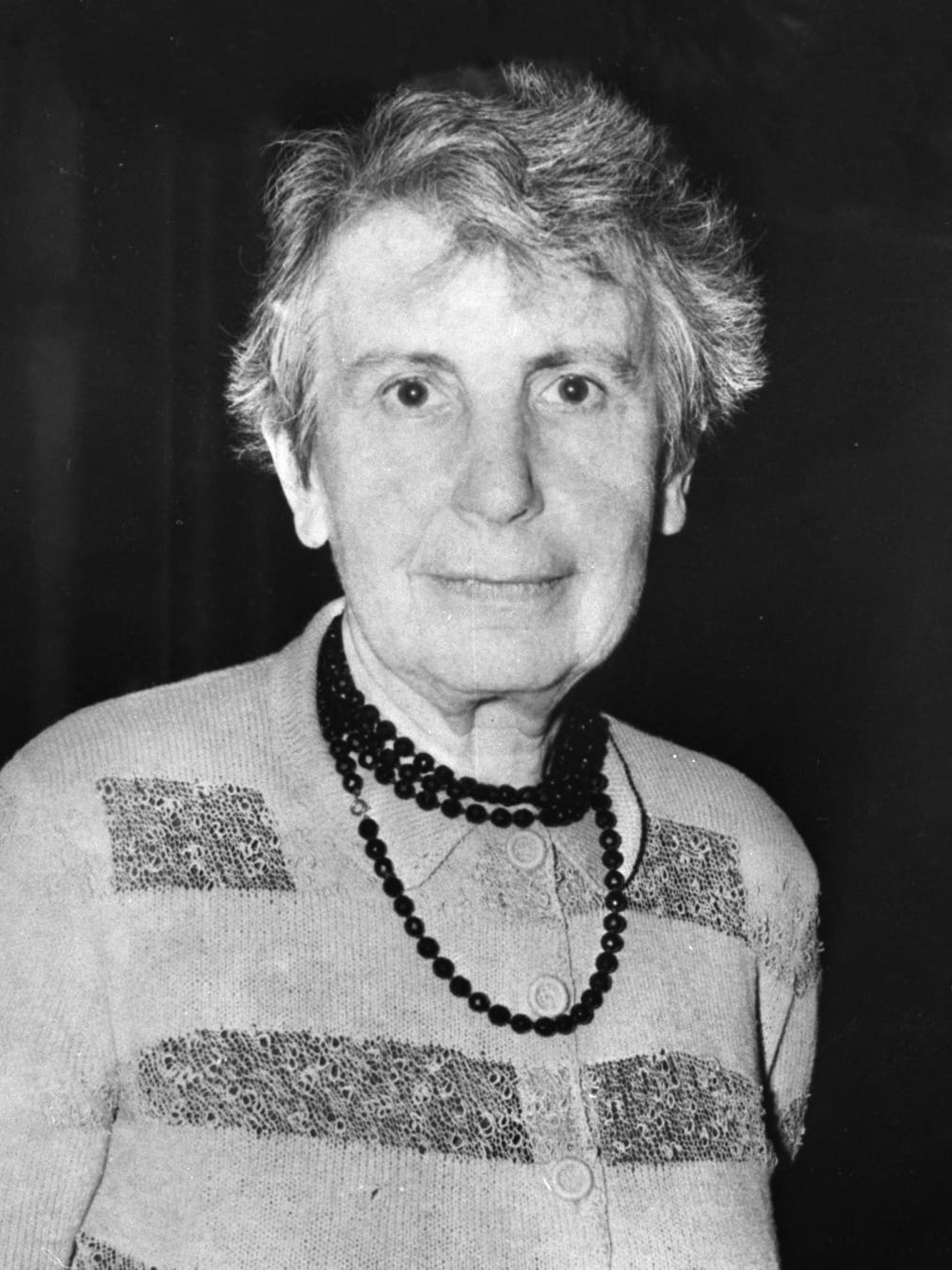
Anna Freud: Child Psychoanalysis and the Development of Ego Psychology

Anna Freud (1957). Public domain via Wikimedia Commons.
Anna Freud (1895-1982) was one of the most significant figures in the history of psychoanalysis and the founder of child psychoanalysis as a distinct clinical discipline. Although she worked in the shadow of her father Sigmund Freud, her theoretical and clinical contributions were original and far-reaching. This article examines her life and training, her development of ego psychology and the theory of defence mechanisms, her pioneering work with children and young people, and the enduring relevance of her ideas to counselling and therapeutic practice today.
Early Life and Training
Anna Freud was born on 3 December 1895 in Vienna, the youngest of Sigmund Freud’s six children. She grew up in an intellectually stimulating household – psychoanalytic ideas were not abstractions for her but the fabric of everyday family life. Her relationship with her father was exceptionally close and, at times, complicated: Sigmund Freud conducted Anna’s own analysis himself, a practice that would later be widely criticised as a serious boundary violation by contemporary clinical standards.
After training as a schoolteacher, Anna Freud pursued psychoanalytic training through the Vienna Psychoanalytic Society, where she qualified in 1922 and subsequently became a member of the Society’s executive. She began clinical work with children, at that time a largely unexplored territory within psychoanalysis. Her early theoretical papers on the technique of child analysis – notably her 1927 book Introduction to the Technique of Child Analysis – established her as a serious thinker in her own right rather than simply her father’s intellectual heir.
When the Nazis annexed Austria in 1938, the Freud family was forced to flee Vienna. Anna Freud was briefly detained and interrogated by the Gestapo – an experience that is reported to have confirmed her resolve to leave. The family settled in London, where Anna Freud would spend the rest of her life and do her most lasting work.
Ego Psychology and the Theory of Defence Mechanisms
Anna Freud’s most influential theoretical contribution came in 1936 with the publication of The Ego and the Mechanisms of Defence. While Sigmund Freud had identified repression as the primary means by which the ego manages anxiety arising from unconscious conflict, Anna Freud systematically catalogued and elaborated a far wider range of defence mechanisms. Her account brought analytical rigour to a concept that had previously been treated in a relatively fragmented way across her father’s writings.
The defences she described include repression, regression, reaction formation, isolation of affect, undoing, projection, introjection, turning against the self, reversal, and sublimation. Each represents a different strategy the ego employs to manage anxiety – particularly anxiety arising from the demands of the id, the superego, or external reality. Anna Freud argued that understanding these mechanisms was essential not only for the treatment of neurosis but for understanding normal psychological development: defences are not pathological in themselves but become problematic when they are inflexible, excessive, or distort the individual’s engagement with reality to a degree that limits functioning.
This focus on the ego – its capacities, its development, and its characteristic ways of managing internal conflict – shifted psychoanalytic attention significantly. Where the early Freudian emphasis had been on uncovering repressed id content, Anna Freud directed clinical attention towards how the ego itself operates and what can be done to strengthen it. This reorientation was the foundation of what became known as ego psychology, a tradition that had considerable influence on American psychoanalysis throughout the mid-twentieth century and that continues to inform psychodynamic formulation today.
The Hampstead War Nurseries
During the Second World War, Anna Freud established and directed the Hampstead War Nurseries in London, a residential programme for children separated from their parents or rendered homeless by the Blitz. The nurseries cared for approximately eighty children at their peak and represented both a humanitarian response to the crisis and an extraordinary natural study in child development and the effects of separation.
The observations Anna Freud and her colleague Dorothy Burlingham gathered during this period were published in Young Children in War-time (1942) and Infants Without Families (1944). Their findings challenged the assumption, then prevalent in social policy, that children’s primary needs during wartime were physical rather than emotional. Separation from the mother – even in comfortable material circumstances – was observed to produce marked psychological distress, and reunion with parents was seen to be more important for children’s wellbeing than safety from bombing. These findings made a significant contribution to what would later become attachment theory, directly influencing the work of John Bowlby.
The Hampstead Child Therapy Course and Clinic
After the war, Anna Freud established the Hampstead Child Therapy Course and Clinic (now the Anna Freud Centre) in 1947, an institution that became one of the world’s leading centres for child and adolescent mental health. The clinic combined clinical treatment with systematic research and the training of child therapists – a model that was innovative for its time and that reflected Anna Freud’s conviction that psychoanalytic ideas about child development needed to be grounded in careful, sustained observation rather than retrospective reconstruction from adult analyses.
One of the most significant methodological contributions to emerge from the Hampstead Clinic was the Developmental Profile – a structured framework for assessing a child’s psychological development across multiple dimensions (libidinal development, ego and superego development, object relations, and so on) rather than simply assigning a diagnostic category. The Profile allowed clinicians and researchers to map a child’s developmental strengths and difficulties systematically and to track change over time. It reflected Anna Freud’s insistence that normal and abnormal development must be understood in relation to each other: pathology can only be meaningfully assessed against an understanding of what healthy development looks like.
This approach produced the concept of developmental lines – the idea that development can be traced along multiple parallel tracks (for example, from dependence to emotional self-reliance, from play to work) and that difficulties in one area do not necessarily indicate global pathology. Understanding a child’s position on these various developmental lines allows a more differentiated and therapeutically useful picture than diagnostic labels alone can provide.
Differences with Melanie Klein
Anna Freud’s approach to child analysis was defined partly in contrast to the rival school of thought associated with Melanie Klein. This disagreement was both technical and theoretical. Klein advocated the direct interpretation of unconscious content in young children’s play, treating symbolic material in the playroom as equivalent to the free association of adult patients. She also proposed that the Oedipus complex and superego formation were present in the first year of life – a position that placed her substantially at odds with Anna Freud’s more gradualist account of development.
Anna Freud argued that the child patient is not simply a small adult: the child’s ego is still developing, the child is embedded in a dependent relationship with parents who continue to exert significant influence on development, and the child lacks the capacity for the kind of verbal free association that provides the primary material of adult psychoanalytic work. Child analysis therefore requires adapted techniques and a different stance, including active engagement with the child’s actual life circumstances rather than a purely intrapsychic focus. She also resisted what she saw as Klein’s tendency to interpret deeply and early in treatment before a working therapeutic relationship had been established.
The Controversial Discussions held within the British Psychoanalytic Society in the 1940s attempted to resolve these disputes and ultimately resulted in an informal division of the Society into three groups – Kleinian, the “B Group” associated with Anna Freud, and a Middle (or Independent) Group. This structural legacy shaped British psychoanalysis for decades.
Later Work and Legacy
Anna Freud continued to develop her ideas on assessment, treatment, and the relationship between developmental research and clinical practice throughout the second half of her career. Her 1965 book Normality and Pathology in Childhood remains an important reference for anyone working with children and adolescents. She also became influential in the field of family law, particularly in relation to child custody and the psychological implications of legal proceedings for children, co-authoring Beyond the Best Interests of the Child (1973) with Joseph Goldstein and Albert Solnit.
She received honorary doctorates from a number of universities, including Harvard, Yale, and Vienna, and was appointed Commander of the British Empire in 1967. She died in London on 9 October 1982 at the age of 86.
The Anna Freud Centre – now the Anna Freud National Centre for Children and Families – continues her work as one of the UK’s leading organisations for children’s mental health research, training, and clinical services. Her influence is most tangible in the fields of child and adolescent psychotherapy, developmental psychopathology, and the integration of developmental observation with clinical practice.
Relevance to Integrative Counselling
Anna Freud’s contributions are relevant to counsellor training across several areas. Her systematic account of defence mechanisms provides a clinically useful framework for understanding how clients manage anxiety and regulate difficult affect – one that remains present in integrative formulation even where the broader psychoanalytic framework is not explicitly adopted. The concept of defences as serving adaptive as well as defensive functions is a useful counterweight to the tendency to pathologise coping strategies that may have been necessary and functional at an earlier point in a client’s life.
Her developmental perspective – the idea that current difficulties must be understood in relation to the trajectory of development rather than simply as current symptoms – informs the kind of historical and relational inquiry that characterises much integrative practice. Her work on children’s responses to separation and loss anticipated key insights of attachment theory, which is now central to several therapeutic modalities widely used in integrative counselling.
More broadly, her career embodies a commitment to grounding clinical practice in systematic observation and to remaining alert to the ways in which theoretical assumptions can mislead if they are not tested against careful attention to what clients – and in her case, children – actually do and feel and need.
Conclusion: Anna Freud’s Place in Therapeutic History
Anna Freud occupies a distinctive and significant place in the history of psychotherapy. She inherited her father’s framework but substantially extended and refined it, bringing the ego into focus as a subject of study in its own right and establishing child psychoanalysis on systematic clinical and observational foundations. Her influence runs through ego psychology, child and adolescent psychotherapy, developmental psychopathology, and – via her documented impact on John Bowlby – attachment theory itself. For trainee counsellors, engaging with her work means engaging with a thinker who insisted that theory must always be answerable to the reality of what children and adults actually experience, and who demonstrated across a long career that clinical rigour and genuine compassion for the human beings in the consulting room are not in tension but are, in practice, inseparable. You can read more about her father’s foundational contributions in our article on Sigmund Freud: The Father of Psychoanalysis, and explore how early relationships shape development in our unit article on Child Development and Attachment Theory.
References
- Freud, A. (1936). The Ego and the Mechanisms of Defence. Hogarth Press.
- Freud, A. (1965). Normality and Pathology in Childhood: Assessments of Development. Hogarth Press.
- Freud, A., & Burlingham, D. (1944). Infants Without Families. International Universities Press.
- Goldstein, J., Freud, A., & Solnit, A. J. (1973). Beyond the Best Interests of the Child. Free Press.
- Young-Bruehl, E. (1988). Anna Freud: A Biography. Summit Books.
- Midgley, N. (2007). Anna Freud: The Hampstead War Nurseries and the role of the direct observation of children for psychoanalysis. International Journal of Psychoanalysis, 88(4), 939-959. https://doi.org/10.1516/ijpa.2007.939
- Anna Freud National Centre for Children and Families. (2024). About Anna Freud. https://www.annafreud.org/about-us/anna-freud/